Keep a steady four-beat count.
Free Sound Detective sample Sample lesson 01
Sound Detective: Build a Four-Beat Rhythm
Students create and perform a four-beat rhythm using one sound, two even sounds, and one silent beat.
Free to preview and download. No signup, payment, or email required. Feedback is optional.
Download teacher guide (PDF)Download student printable (PDF)Download classroom slides Back to Open & Teach Music home
- Grades 3-5
- 20-minute core; first 10-minute extension makes 30 minutes total; all three 10-minute extensions make 50 minutes total
- No instruments needed
THE PLAN
One lesson, ready to lead
Students create and perform a four-beat rhythm using one sound, two even sounds, and one silent beat.
Use TA, TI-TI, and REST cards to make a pattern.
Perform the pattern so a listener can hear the silent beat.
Prepare: This lesson and its printable rhythm cards. A board or display for the classroom prompts; if printing is unavailable, draw the rhythm cards and four beat boxes. No instruments or special equipment.
TEACHER PREPARATION
Set up in a few minutes
The lesson can run from the page or a board. Printed cards are optional, and separate audio playback is not required.
- Before class, print and cut the three rhythm tiles or write TA, TI-TI, and REST on the board. Draw four boxes in a row for the pattern strip.
- Choose a still-hands attention signal and model it once before the first echo.
- Set a comfortable sound level. Offer pointing or silent counting so students can participate without making a sound or moving.
Rhythm language to model
- Beat
- One counted space in the steady 1, 2, 3, 4 pulse.
- TA
- One sound that lasts for one beat.
- TI-TI
- Two even sounds that fit inside one beat.
- REST
- No sound for one beat; keep the count moving silently.
- Pattern
- An ordered group of sounds and rests that can be repeated.
20 MINUTES
A timed sequence and teacher script
Read the cues as written or adapt them to your classroom voice.
0:00-2:00 | Welcome and listening signal
Set a calm routine and introduce the sound-detective challenge.
- Teacher: Today we will listen for a pattern, copy it, and make one of our own. We do not need instruments; our voices and hands are enough.
- Teacher: When I say "Sound detectives," place your hands still on your knees and look toward the rhythm cards. Let us try it once.
- Teacher: Sound detectives. Thank you. Our goal is to make four steady beats that another person can follow.
Students do: Respond to the attention cue. Choose a seated knee tap or a quiet clap for the activity.
Listen for: Everyone has a comfortable, instrument-free way to participate.
2:00-5:00 | Model the three rhythm sounds
Hear the difference between one sound, two even sounds, and one silent beat.
- Teacher: TA is one sound across one beat. Copy me: TA. Now count four steady beats with me: 1, 2, 3, 4.
- Teacher: TI-TI is two even sounds inside one beat. Listen first, then echo: TI-TI. We still count that space as beat 1.
- Teacher: REST means one quiet beat. Keep the count moving inside your head while your hands stay still: 1, 2, 3, 4.
- Teacher: I will show a card before we perform it. Our sound stays soft enough for everyone to hear the count.
Students do: Echo each cue once. Tap or clap TA and TI-TI; show REST by keeping hands still while silently counting.
Listen for: Students distinguish the silent beat from stopping the whole count.
5:00-9:00 | Listen, echo, and switch
Practice reading a short pattern while keeping the pulse steady.
- Teacher: Watch the four cards. I will perform the pattern once. Listen without copying: TA, TA, TI-TI, REST.
- Teacher: Now echo it with me. Keep four beats in your count: 1, 2, 3, 4.
- Teacher: This time, I will point to each card and you will perform. If you lose your place, rejoin on the next beat.
- Teacher: Turn to a partner. One person points to the cards; the other performs. Then switch jobs.
Students do: Echo the model, perform from the visual cards, then take turns pointing and performing with a partner.
Listen for: Listen for four counted beats and a quiet, intentional REST.
9:00-14:00 | Make a four-beat pattern
Compose a repeatable pattern with a clear beginning and ending.
- Teacher: Your group will choose four cards, one for each beat. You may repeat a card. Make sure your pattern has four beats total.
- Teacher: First point and count the four spaces. Next, practice the pattern quietly. Then choose who points and who performs.
- Teacher: If your pattern uses TI-TI, fit both sounds evenly into that one beat. If you choose REST, keep the beat going silently.
- Teacher: Freeze, hands still, eyes up. Check your four spaces. Make one change if your group wants a new sound order.
Students do: Arrange four cards in a row, count the spaces, rehearse, and choose a pointer and performer. A student may do both roles.
Listen for: Every group has four spaces and a pattern it can perform together.
14:00-18:00 | Share and listen
Perform a student-created pattern and listen for its structure.
- Teacher: Performers, point to each beat as you play your pattern. Listeners, keep the count silently and notice one sound choice.
- Teacher: Let us count together: 1, 2, 3, 4. Thank you. Listeners, show one finger if you heard a REST.
- Teacher: I noticed your group kept the beat moving through the quiet space. That helped the pattern stay together.
- Teacher: We will hear one more pattern. Our audience rule is eyes on the pointing hand and quiet hands until the ending.
Students do: Selected groups perform. Listeners silently count four beats and signal whether they heard a REST.
Listen for: The listener response gives the performer useful evidence without ranking groups.
18:00-20:00 | Quick assessment and close
Check each learner can make and explain a four-beat pattern.
- Teacher: On your four-box strip, draw or place four rhythm cards. Point to each box and count 1, 2, 3, 4.
- Teacher: Show me your REST with still hands. Tell me how you keep the beat going during the quiet space.
- Teacher: Before we finish, name one sound you used and one thing you would change next time.
Students do: Complete a four-box pattern, point and count it, then show or say where the silent beat occurs.
Listen for: Use the quick assessment below to decide who is ready to extend and who needs another model.
CLASSROOM SLIDES
Designed 16:9 classroom slides
The PDF is student-facing. The editable PowerPoint keeps teacher directions in slide speaker notes.
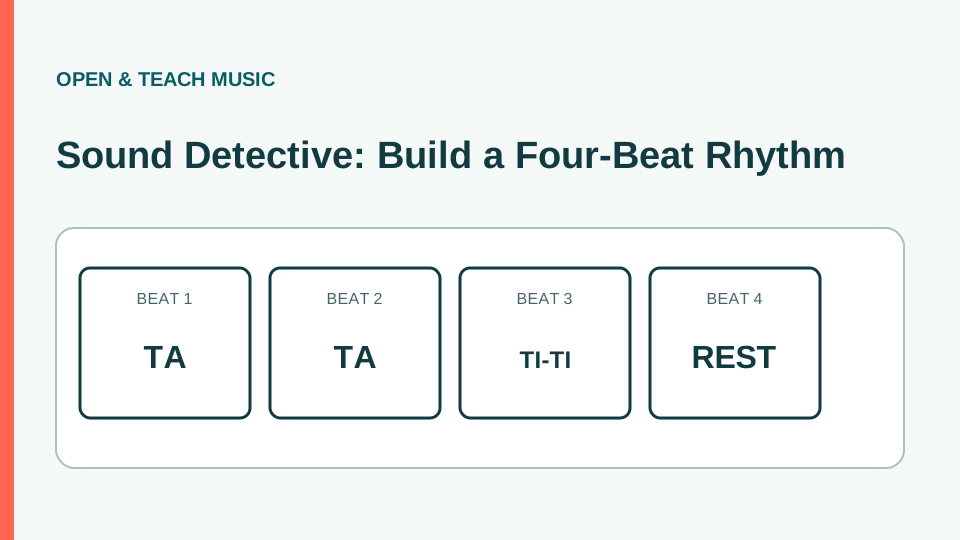
Eight student-facing slides use original beat-box graphics and notation examples. The teacher guide and speaker notes keep the scripts separate from classroom display text.
PRINTABLE MATERIALS
Rhythm tiles and a four-beat strip
Print this page, cut apart the three rhythm tiles, and use them to build a four-beat pattern. A student may point, say the rhythm syllables, tap quietly, or silently count.
ONE SOUND | ONE BEAT
TWO EVEN SOUNDS | ONE BEAT
QUIET FOR ONE BEAT | KEEP COUNTING
Student or group: __________________________________
QUICK ASSESSMENT
Check understanding in the final two minutes
- Four-beat count: student points to or names four spaces in order without skipping a box.
- Rhythm meaning: student shows one sound for TA, two even sounds within one beat for TI-TI, and one silent beat for REST.
- Steady pulse: student continues the count by voice, finger point, or silent tracking during REST.
Have partners point to their own four-box strip while the teacher circulates and listens for the three checks. A student who meets all three is ready to extend. If the count breaks at REST, model a two- or three-box pattern and rebuild to four.
OPTIONAL EXTENSIONS
First 10-minute extension: 30 minutes total
All three 10-minute extensions make 50 minutes total.
20:00-30:00 | Add a sound level choice (10 min)
Teacher: Keep the same four-beat pattern. Choose soft or a comfortable speaking level; no shouting. First perform it at one level, then change only the sound level. Listeners, keep a quiet four-beat count and name the level you heard. Switch roles and try both levels again.
Students do: Perform the same pattern at two comfortable levels, keep the pulse steady, identify the difference, and switch pointer and listener roles.
30:00-40:00 | Create a contrasting version (10 min)
Teacher: Change one card to make a new version. Point to the changed beat and tell your partner what changed before you perform. Rehearse both versions, keeping the count and every unchanged beat steady. Switch roles so each partner can make or lead a change.
Students do: Revise one card, rehearse and compare the original and new pattern, then switch roles and describe the changed beat.
40:00-50:00 | Perform and reflect (10 min)
Teacher: Perform both versions for a partner or small group. Listeners, identify the changed beat and keep the count through any REST. Composers, tell us how the change affected the pattern and which choice made the contrast easiest to hear.
Students do: Share both versions, listen for the changed beat, and explain one choice that made the contrast easy to hear.
KEEP THE ROOM READY
Classroom-management tips
- Teach the still-hands attention cue before the first echo. Practice it once when the room is quiet.
- Set the sound level at a comfortable speaking voice or softer; avoid asking students to shout.
- Offer seated knee taps, quiet claps, pointing, or silent counting so movement is optional.
- Use one pointer and one performer per pair, then switch. Students may combine roles when needed.
- During sharing, listeners count silently and offer one observation about the pattern, not a rating of the performer.
- If the room gets noisy, stop, use the agreed cue, wait for still hands, and restart with one four-beat model.
MAKE IT ACCESSIBLE
Grades 3–5 scaffolds and challenge
- Entry point: begin with two boxes using TA and REST, then expand to four once the student keeps counting through the quiet beat.
- Core practice: build and perform a four-beat pattern that includes at least one REST; switch the pointer and performer roles.
- Challenge: create two different four-beat patterns, change one beat, and explain how the sound changed while the count stayed at four.
- Participation options: point to cards, speak or whisper the syllables, use a gentle seated knee tap or quiet clap, or silently count. Movement and performing aloud are optional.
- Keep the visual beat boxes in view while modeling each pattern; no recording or separate audio file is needed.
OPTIONAL EDUCATOR FEEDBACK
How might this fit your classroom?
Rate the lesson and briefly share where it might fit your classroom or what support would help. Feedback is optional; the preview and download remain open without it.
OPEN FILES · NO ACCOUNT REQUIRED
Download the complete resource set
Each link opens a file in this lesson’s resource folder. No signup or payment is required.
- Sound Detective teacher guideCover, objectives, timed teacher cues, student actions, extensions, and assessment.Download PDF
- Classroom slidesStudent-facing presentation pages with large text and original musical graphics.Download 16:9 PDF
- Editable classroom slidesEditable slides; teacher directions are in speaker notes.Download PowerPoint
- Student printableBlack-and-white-friendly activity sheet with graphical boxes and cut-out cards.Download PDF
- Lesson textEditable source text for the supplied lesson sequence.Download Markdown
- Live teacher cue guideLive modeling cues with lesson-time markers; no MP3 is supplied.Download TXT
- Curriculum alignment notesCited connections and items that are partial, unsupported, or unverified.Download Markdown
- Slide previewA visual preview of the classroom slide design.Open preview
No MP3 is included. The text cue guide is for live teacher modeling and is not an audio recording.